For months the same customer complaint came up in our weekly meeting, and for months we treated it as noise: apologise, log it, move on. Then one person on the team asked what those customers were actually trying to do when it went wrong. The answer took five minutes to find, it became a simple new routine at the counter, and the complaint stopped. If you want to know how to manage a creative thinker, start with that question: it is what they are for, and it is also why they can wear a team out.
This is the field guide for that person: what a creative thinker brings to a team, where they get stuck, and what to say so the ideas turn into something that ships. Written for managers. If the person who asked what the customers were trying to do sounds like you, read it as a mirror.
A creative thinker, the Visionary in the Best of Motivation four-style model, decides by generating options. Where others see one way through a problem they see six, some of them odd, one of them right. Other names for the same style: lateral thinker, innovative thinker, ideas person. Their strength is possibility. Their blind spot is that possibility has no natural stopping point, so the idea keeps growing while nothing gets chosen.
What Is a Creative Thinker?
A creative thinker is someone whose first move, when a problem lands, is to widen it. Not to solve it as posed, not to check its numbers, but to ask whether it is the right problem and what else the situation could become. In the four-style model we use at Best of Motivation, this is the Visionary, alongside the Analytical Examiner, the Practical Doer and the Strategic Planner.
Three of the four styles draw on Robert Sternberg’s triarchic theory of intelligence, set out in Beyond IQ (1985), where creative intelligence is the ability to handle novelty: to cope with new situations and produce new ideas. The strategic style is our own addition, drawn from the best part of twenty years in leadership roles, supervisor to senior manager. It is a practical way to talk about how people decide at work, not a psychometric test. Creative thinking in Sternberg’s sense is not about art. It is about novelty: seeing a familiar problem as if it were new.
Two things separate a creative thinker from someone who just likes talking. First, their ideas connect things that were not connected: a customer complaint and the way the counter runs. Second, they are energised by the blank page that scares everyone else. Give them an open brief and they light up. Give them a checklist and they wilt.
How Do Creative Thinkers Decide? Strengths at Work
Creative thinkers decide late and widely. They want all the options on the table before they pick one, and they will add options while everyone else is trying to choose. That produces four strengths a team comes to rely on.
- They reframe the stuck problem. When a team has argued itself into a corner, the Visionary is the one who moves the corner.
- They see the customer’s version. Creative thinkers imagine other people’s experience naturally, which is why their ideas often start from the shop floor, not the spreadsheet.
- They keep a team from going stale. Same process, same result. The Visionary is the reason the process changes.
- They are fearless with the first draft. A rough version on the table beats a perfect version in someone’s head, and they will put the rough one down.
Under pressure this style gets more inventive, not less. Give a creative thinker a crisis and they will generate five ways out in the first ten minutes. That is a gift. It also means the room has five new problems to evaluate, which is where the blind spots begin.

Creative Thinker Blind Spots
The main blind spot: the Visionary never runs out of options, so nothing gets chosen. Every meeting ends with more ideas than it started with. Momentum feels like progress. It is not, until one idea is picked and the rest are parked.
Three smaller ones travel with it.
- Boredom with the second half. The idea is the exciting part. Delivery is someone else’s problem, until it is nobody’s.
- Hearing “how much?” as “no”. When the analytical thinker asks for a cost, the Visionary hears the idea being rejected. Usually it is being taken seriously.
- Changing the plan because a better one appeared. There is always a better one. Teams cannot ship against a moving target.
The question a creative thinker should keep on a sticky note: which one of these am I going to finish? Not which is best. Which one gets finished. The best idea that ships beats the better idea that does not.
How to Manage a Creative Thinker
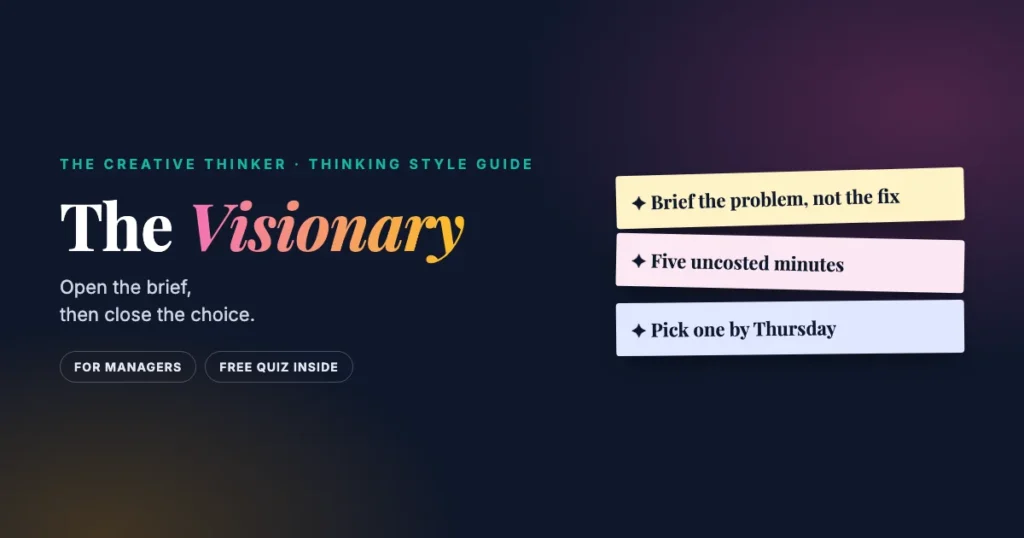
Managing a creative thinker comes down to one principle: open the brief, then close the choice. Give them room at the start and a hard edge at the end. They will fill the room. Your job is to build the edge.
- Brief them with the problem, not the solution. “Customers keep complaining at the counter” gets you six ideas. “Put up a sign” gets you a tired nod.
- Give the idea five uncosted minutes. Ask the room, out loud, to hold the “how much?” until the option is fully described. The idea survives long enough to be judged fairly.
- Set the choosing moment in advance. “We pick one by Thursday.” The date does what the Visionary cannot do for themselves: it stops the generating.
- Give feedback on the outcome, and name what was good. “The idea was right, we chose too late” is heard. “You are all over the place” is not, because from inside it feels like abundance.
- Pair them with a practical thinker for delivery. The Doer asks “what do we do first?” and the Visionary answers it, once. Then the Doer runs it.
- Park ideas visibly. A written list of “not now” ideas lets the Visionary let go. An unwritten one keeps coming back into the meeting.
Two related reads: communicate to simplify is the discipline that turns a creative thinker’s six ideas into one the team can repeat, and leading through change without losing your team covers the delivery half the Visionary tends to skip.
Three moves for this week
If you manage a creative thinker, here is the sketchbook version.
- Rewrite one brief on your desk as a problem instead of a task, and give it to them.
- In your next meeting, say “five minutes, no costing” before their idea, and mean it.
- Start a visible “not now” list. Add their second-best idea to it, in front of them.
Creative Thinker vs Analytical, Practical and Strategic Thinkers
Friction between styles is rarely about the goal. It is two people asking different first questions. The table gives each pairing and one sentence the creative thinker can open with, the same kind of line the free quiz report gives you.
| Pairing | Where it grinds | Open with |
|---|---|---|
| Creative + Analytical (the Examiner) | The Examiner costs the idea while it is still forming. | “Show me the two figures that would change your mind.” |
| Creative + Practical (the Doer) | The Visionary is still exploring while the Doer wants the first step. | “What would you do in the next hour?” |
| Creative + Strategic (the Planner) | The Planner has already sequenced the idea the Visionary has just replaced. | “Which of these keeps the most options open?” |
The full breakdown of all four styles, and what a team with a missing style looks like, is in The 4 Types of Thinkers.
Are You a Creative Thinker?
If the blind spots read like your last three projects, the free Thinker Quiz takes two minutes, shows your dominant and secondary style, and gives you a short AI-written report on how you decide under pressure, your blind spot, and three moves for the week. Most people are a blend. The creative thinker with a practical secondary is, in my experience, one of the most valuable people on a team, because they both have the idea and finish it.
The free Thinker Quiz shows your dominant and secondary style, then gives you a short AI-written report: how you decide under pressure, how to work with the other three styles, your blind spot, and three moves for this week. Free: add your email and your result appears on screen, with the report.
Take the free Thinker Quiz →The routine stuck, and the complaint stopped coming up. The person who asked the question did not build it; a practical thinker did, and they were both glad of it. That is the whole lesson: the idea and the delivery are two jobs. Let the Visionary do the one only they can.