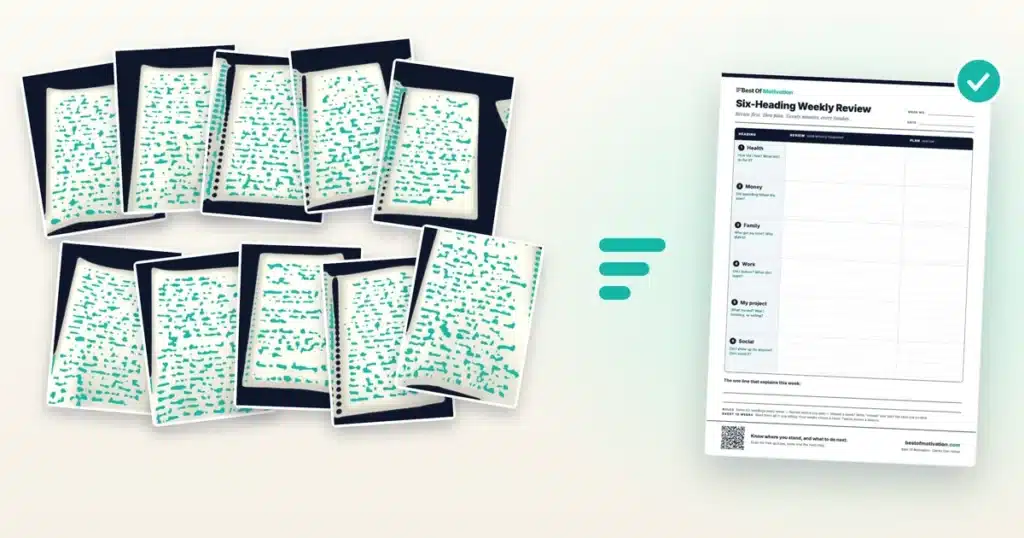
You work all week. You get things done. Sunday arrives and you cannot say what actually moved. The job took the hours. The thing you are building took the scraps. Family got what was left. And next week starts with the same list. The weekly review template below fixes that in twenty minutes.
Not an app. Not a thirty-question journal. One page, six headings, and a rule most people skip: look back before you plan forward.
This is the review I run myself, after the best part of twenty years in leadership roles, supervisor to senior manager, and seven years building something of my own on the side. It is the only habit that has kept both honest at the same time.
In short: a weekly review is a fixed 20-minute check on the main areas of your life, done on the same day each week. This weekly review template uses the same six headings every time (health, money, family, work, your project, social). You write what actually happened under each one, then one line of plan. It is also called a weekly reflection, a weekly life review or a weekly reset. The review comes first. The plan comes second.
Why so many weekly reviews fade by week three
Search “weekly review template” and you will find hundreds. Notion boards, printable planners, five-page reflection journals. Many people try one, keep it for a fortnight, and quietly stop.
The weekly review as a named habit goes back to David Allen’s Getting Things Done (2001), where it keeps your task lists current. That version is about tasks. This one is about your life, and it has to survive a tired Sunday night.
Three reasons come up again and again:
- Too many prompts. Twenty questions on a Sunday night is homework. You skip it once, then twice, then it’s gone.
- Plan without review. Many templates jump straight to “goals for next week”. So you write the same goals you wrote last week, with no idea why they didn’t happen.
- No fixed shape. Free writing feels good once. But without the same headings every time, you can never compare one week to the next. Patterns stay hidden.
The fix is not a better app. It is fewer headings, the same ones every week, and the discipline to review first.
The weekly review template: six headings
Six areas. The same six, in the same order, every week. Each one gets a few lines about what happened, then one line about what comes next. That’s the whole structure.
1. Health: How did I feel, physically and mentally? What did I do for it? What did I avoid?
2. Money: Did spending follow the plan? Where did money go that it shouldn’t have? What is money for right now?
3. Family: Who got my time? Who didn’t? One honest line per person who matters.
4. Work: Did I deliver? What drained me? What did I learn that I can use?
5. My project: The side business, the course, the thing you’re building. What moved? What didn’t? Was I building, or selling?
6. Social: Did I show up for anyone outside the house? Did I avoid it? Why?
 Get the free one-page template (PDF, no email needed)
Notice what’s missing. No “wins and gratitude” column. No “mood tracker”. Those are nice, but they don’t change decisions. The six headings cover the areas where your choices actually land.
Rename them if you need to. A single person might swap “Family” for “Relationships”. Someone without a side project might make heading five “Learning”. The names matter less than the rule: same headings, every week.
How to do a weekly review in 20 minutes
Pick a fixed slot. Sunday evening works for a lot of people. I find paper works better than a screen, because a notebook doesn’t have notifications. Then:
That’s it. Twenty minutes. The review gets shorter as the habit settles, because you stop writing things you already know.
The review-first rule. If you only have five minutes, review and skip the plan. Never plan and skip the review. A plan without a look-back is just last week’s list with a new date on it.
What a weekly reflection teaches you that planning never will
Goal-setting tells you where you want to go. The review tells you why you aren’t there yet. Three things it surfaces that a planner does not:
Write the hard question, then answer it
Some weeks the Work heading is not pleasant. You write “busy all week and proud of none of it”, or “why did that one meeting get to me”. Leave it on the page. Then keep writing. More often than not you answer your own question two lines later, because the act of writing it down takes the heat out of it. The review is where you argue yourself out of a bad mood, with evidence.
The job and the project are on the same side
If you have a job and something you’re building, the Work and Project headings sit next to each other on purpose. Over a few weeks a pattern shows up: a rough week at work is often impatience with the project in disguise. Once you see that, you stop blaming the job for it. The job gives you a steady base and real problems to learn from. The project gives you somewhere to use what you learn. Each one makes you better at the other. You only see that by reviewing both side by side.
Patterns only show after four weeks
One review is a snapshot. Four reviews are a trend. The heading you keep writing “nothing moved” under. The plan line you keep copying forward. The week that always goes wrong after a late shift. None of that is visible on a Sunday. All of it is obvious by the end of the month, if the headings never change.
Take the free Thinker Quiz: how do you process a week?A filled-in weekly review template: a full-time job and a side project
Here is a real review, trimmed, with the identifying details removed. Someone mid-career with a full-time management job, building a side project in the evenings.
| Heading | Review (what happened) | Plan (one line) |
|---|---|---|
| Health | Steady. Feeling consistent. Not exercising but feeling good. Week off was good for the head. | Start exercise or meditation. Even one hour this week is a gain. |
| Money | Holiday paid. Last month’s spare money went into the business. Need to watch the gap between spending and the plan. | Review the last 30 days. Cut what isn’t an investment. |
| Family | Eldest is doing his own thing now. See him less, and that’s right. Younger ones settled into the new school term. | Quality time. Find a healthier way to interact than screens. |
| Work | Rollercoaster. Came back from the week off restless. Worked out that most of it was impatience with the project, not the job. | Clear head. Deliver the job well. Leave the project at home. |
| Project | Intense. New products, new articles, clearer direction. One sale, then none. Been building, not selling. | Keep sharpening, but shift the hours to sales. |
| Social | Slow. Went to more events on holiday but stayed inside the circle. Avoid “time-wasters”, which is also avoiding people. | Be proactive. One event. |
Look at the Work line. The review started in frustration and ended with the real cause. That didn’t come from a goal-setting exercise. It came from writing the week down honestly and reading it back.
Now look at the Project line. “One sale, then none. Been building, not selling.” That sentence, left on the page, is worth more than a month of to-do lists. It is the one line that matters.
How to keep a weekly review going: the Sunday rule
The habit lives or dies on one thing: the same slot, every week, no exceptions for good weeks. Good weeks are the ones you learn least from, because you don’t bother to write them down.
- Same notebook. Don’t scatter reviews across apps. Flipping back four pages is the whole point.
- Number the weeks. “Week 39” at the top, not a date. It makes the gaps visible.
- Missed one? Write “missed” and move on. Don’t catch up. Don’t double up. Just start the next one on time.
- Every 12 weeks, read all of them in one sitting. That’s your quarterly review, and it writes itself.
Pair it with a short morning routine and you have the two ends of the week covered: a few minutes to point the day, twenty minutes to read the week. If you prefer to think out loud, these journaling prompts make a decent warm-up before the six headings. And when a plan line turns into something bigger, this guide to setting goals picks up where the review leaves off.
A weekly review won’t make the job easier or the project faster. It will make sure you can see both clearly, every seven days, before either one drifts. That’s the whole habit. Review first. Then plan. Then get on with the week.
The exact layout from this article: six headings, review column, plan column, week number at the top. Print it, pin it, use it every Sunday. No app and no email needed.
Get the free one-pagerWeekly review template: common questions
People read a week back in different ways. The free Thinker Quiz shows which of four thinking styles is yours.
Take the free Thinker QuizPart of the self-improvement journey series. For a daily version of this habit, see how to analyse your day.