
How to improve leadership skills
The title is not the problem. The habits are.
You are already leading something: a shift, a project, a small team. The gap is a handful of habits nobody ever showed you, and habits can be learned.

Why it matters
70%
of the variance in team engagement comes down to the manager.
The manager is the single biggest factor in how a team performs.
Gallup, State of the Global Workplace (2025)
The real gap
Not knowledge. Practice.
Most people know what good leadership looks like.
Nobody sits down and works on delegation the way they would work on a spreadsheet skill.
The whole idea
- 1Pick two strategies
- 2Practise them for a month
- 3Then pick the next two
Seventeen at once is a reading list, not a plan.
Start with the gap you notice most
- Feedback keeps surprising youStart with self-awareness. You cannot fix what you cannot see.
- Meetings run long and nothing landsCommunication. Fewer words, clearer asks.
- You do everything yourselfDelegation. Your team cannot grow on tasks you keep.
Or start here
- Decisions stall for weeksDecision-making. Decide with what you have, then adjust.
- The team avoids hard conversationsConflict resolution. Early and calm beats late and loud.
- You are running on emptyResilience. Nobody leads well tired.
Strategy 8 · Delegation
Delegate to grow people, not to offload.
- MatchGive tasks to people with the skills, or the promise.
- ClarifySet clear objectives, timelines and resources.
- SupportCheck in, but leave the how to them.
Make it stick
Most people read a guide like this, nod, and change nothing.
The 90-Day New Manager Accelerator: a week-by-week plan for your first months.
Get the Accelerator · £37 →Leading for a while? Clarity-First Leadership Playbook · £7
Most people who want to know how to improve leadership skills are already leading something: a shift, a project, a small team, a family. The title is not the problem. The gap is usually a handful of habits that nobody ever showed them, and habits can be learned.
That is what this guide is for. Seventeen strategies to develop your leadership skills, each with a reason it matters and a way to practise it this week, plus a bonus on using AI and a short list at the end to help you pick where to start. No theory you cannot use on Monday.
In short
Leadership skills are the practical abilities that let one person guide a group toward a shared result: self-awareness, clear communication, sound decisions, delegation, accountability and resilience. They are learned behaviours, not personality traits. The best way to improve or develop them is the same as for any skill: pick one or two, practise them deliberately for a month, ask for honest feedback, and repeat. This guide covers 17 strategies, each with a short exercise, that you can start this week whether or not you hold a management title.

Prefer to listen? The Best of Motivation podcast covers the shift from command-and-control to influence in Transformational Leadership: From Command to Inspiration (12 minutes).
What Are Leadership Skills?
Leadership is the ability to guide, motivate and influence other people toward a shared goal. It is not limited to people with “manager” or “director” in their title. Leaders show up at every level, and what they share is a mix of self-awareness, emotional intelligence, clear communication and good judgement.
Leadership used to be treated as something you were born with. Research and everyday experience both say otherwise: these are behaviours, and behaviours can be practised, measured and improved like any other skill.
Free · 5 minutes
Your way of leading works with some of your team and not others? That is not a failing: different people need different styles. Find the one you default to, and the single move that reaches the rest.
Or see how your personality colour shapes the way you lead.
Research
The Center for Creative Leadership names four core skills that matter at every stage of a career: self-awareness, communication, influence and learning agility. Most of the strategies below build one of those four.
Source: Center for Creative Leadership, 4 Core Leadership Skills You Need in Every Role
If your own energy is the thing running low, motivation for success covers the other half of the problem.
Why Improve Your Leadership Skills?
The manager is the single biggest factor in how a team feels and performs. Gallup’s State of the Global Workplace 2025 report puts it plainly: 70% of team engagement is attributable to the manager. The same report found that only 21% of employees worldwide were engaged at work in 2024, and that the fall was driven by managers themselves, whose engagement dropped from 30% to 27%. Teams take their cue from the person leading them.
Trust is a big part of that. Paul Zak’s research, published in The Neuroscience of Trust (Harvard Business Review, 2017), found people in high-trust organisations reported 74% less stress and 50% higher productivity than those in low-trust ones. Trust is built by the leader, one interaction at a time.
In the best part of twenty years in leadership roles, supervisor to senior manager, the gap I have seen most often is not knowledge. Most people know what good leadership looks like. The gap is practice: nobody sits down and works on delegation the way they would work on a spreadsheet skill. That is the gap this guide closes.
Leadership vs Management: What Is the Difference?
The two overlap, but they are not the same thing. Leadership sets direction, earns commitment and builds an environment where people do their best work. Management runs the processes, coordinates the tasks and keeps things efficient. Most roles need both. A team that is only managed gets the work done; a team that is also led gets better at it.
“Management is doing things right; leadership is doing the right things.” Peter Drucker
If you have just stepped into your first management role, start with the leadership skills for new managers guide, a 90-day plan for the transition itself. This article covers the broader set of skills every leader keeps building after that.
How to Improve Leadership Skills: 17 Strategies
Each strategy has two parts: why it matters, and a way to practise it this week. Work on two at a time. Seventeen at once is a reading list, not a plan.
1. Cultivate Self-Awareness
Good leadership starts with knowing your own strengths, blind spots and habits under pressure. You cannot fix what you cannot see.
- Reflect daily: spend 10 minutes at the end of the day on one interaction. What went well, what did not, and what you would do differently.
- Ask for feedback: ask two people one specific question, such as “What is one thing I do in meetings that gets in the way?”
- Personal SWOT: list your strengths, weaknesses, opportunities and threats on one page, then pick one weakness to work on this month.
2. Develop Emotional Intelligence
Emotional intelligence is the ability to read and manage your own emotions and other people’s. It shapes how you handle conflict, feedback and pressure, which is most of leadership.
- Practise empathy: before you respond to a complaint, ask one open question and listen to the whole answer.
- Name your triggers: note the situations that make you react fast and hard. Knowing them is most of managing them.
- Listen actively: paraphrase what you heard before you reply, and resist the urge to interrupt.
Worth knowing: TalentSmart, a company that sells EQ assessments, reports from its own testing that 90% of top performers score high on emotional intelligence. Treat the number as directional rather than proof, but the pattern matches what most managers see.
3. Master Effective Communication
Communication is how direction, feedback and trust actually reach people. A clear leader saves the team hours of guessing.
- Be brief and clear: before your next update, write the one sentence you want people to remember, and lead with it.
- Pick the right channel: sensitive conversations happen face to face or on a call, never by email or chat.
- Give feedback that lands: describe the behaviour, explain its impact, and say what you need next. “You were late three times this week” opens a conversation; “you are unreliable” closes one. More in how to give feedback.
4. Sharpen Decision-Making Skills
Leaders make decisions every day, from rotas to hiring to priorities. Good ones balance evidence, judgement and timing, and a slow decision is often worse than an imperfect one.
- Gather the facts that matter: list the two or three pieces of information that would change your mind, and get only those.
- Weigh short against long: for each option, write what it gains this month and what it costs in six months.
- Set a deadline: give each open decision a date. Decide with what you have, then adjust.
5. Become Adaptable and Agile
Plans change, teams change and tools change. Leaders who stay flexible keep the team moving when the original plan stops working.
- Treat change as information: when a plan breaks, ask “what does this tell us?” before “whose fault is it?”
- Run small experiments: let the team try one new way of doing a routine task for two weeks, then keep it or drop it.
- Stay current: spend 15 minutes a week on what is changing in your field, including the tools your team could use.
6. Foster a Growth Mindset
A growth mindset, the term popularised by psychologist Carol Dweck, is the belief that abilities can be developed with effort. Leaders who show it give their team permission to learn out loud.
- Notice progress: recognise one small improvement this week, not only the final result.
- Normalise mistakes: share one of your own mistakes and what you learned from it.
- Set a learning goal: choose one new skill to learn this quarter, for you or the team.
7. Build Trust and Credibility
Trust holds a team together. Without it, people hold back ideas, hide problems and stop taking risks.
- Be open: share the context behind a decision, including the parts that are not good news.
- Follow through: write down every promise you make this week and close each one, or say early why you cannot.
- Be fair: apply the same standard to everyone, including the people you get on with best.
The numbers: Paul Zak’s The Neuroscience of Trust (Harvard Business Review, 2017) found people in high-trust companies reported 74% less stress, 50% higher productivity and 29% more satisfaction with their lives than people in low-trust companies.
8. Learn to Delegate and Empower
Delegation is not offloading. It is how people grow their skills and take ownership, and it frees you for the work only you can do.
- Match the task: give one task this week to someone with the skills, or the promise, to do it.
- Be clear: agree the outcome, the deadline and the resources before they start.
- Support, do not micromanage: agree one check-in point, and leave the how to them.
9. Practise Consistent Accountability
Accountability means everyone, including you, owns what they said they would do. It sets the standard more than any speech does.
- Make success visible: agree two or three measures with the team so everyone knows what good looks like.
- Own your mistakes: when you get a call wrong, say so, and say what you will do about it.
- Check in regularly: keep a short, steady rhythm of one-to-ones. The one-on-one meeting template gives you the structure.
10. Promote Collaboration and Inclusivity
Teams that hear from everyone solve problems better. Different views catch mistakes that a like-minded group misses.
- Hear the quiet voices: in your next meeting, ask the people who have not spoken for their view before you close.
- Mix the group: put people with different skills on the same problem.
- Share opportunities fairly: rotate the visible tasks and the training places, not just the routine work.
11. Inspire Through Vision and Purpose
People work better when they can see why their part matters. A clear purpose keeps a team pointed the same way when things get hard.

- Say it in one line: write what your team is for in one sentence, and test it on them.
- Connect the dots: when you hand out a task, say what it feeds into.
- Show you care about it: energy is contagious. If the goal matters to you, let it show.
12. Strengthen Conflict Resolution Skills
Conflict is normal in any team. Handled early and calmly, it makes relationships stronger; left alone, it spreads.
- Act early: name one tension you have been avoiding and raise it this week, privately.
- Hear every side: let each person explain their view in full before you suggest anything.
- Solve, do not blame: steer the conversation to “what do we do now?” rather than “who caused it?”
13. Implement Coaching and Mentoring
The best leaders grow other people. Coaching is not micromanagement: it is asking the questions that help someone find their own answer.
- Coach in your one-to-ones: ask “what would you try?” before you give your answer.
- Pair people up: match two team members whose skills complement each other.
- Share what helped you: pass on one article, book or course that made a difference to you.
14. Leverage Feedback Loops
Feedback only works when it is regular and goes both ways. A steady loop catches problems while they are still small.
- Make it routine: set a weekly or monthly slot for feedback, so it is never a surprise.
- Invite it upward: ask your team what you should start, stop and keep doing.
- Act on it visibly: change one thing based on what you heard, and say that you did.
15. Invest in Continuous Learning
The skills that got you here will not cover everything that comes next. Leaders who keep learning stay useful to their team.
- Plan it: pick one leadership skill to develop each quarter.
- Use what is free: online courses, books and podcasts all count, and many cost nothing.
- Learn from peers: ask a leader you respect how they handle the thing you find hardest.
16. Set SMART Goals for Leadership Growth
SMART goals (Specific, Measurable, Achievable, Relevant, Time-bound) turn “be a better leader” into something you can actually track.
- Be specific: instead of “improve communication”, try “send a five-line team update every Friday”.
- Track it: use something you can count, such as feedback scores or delegated tasks completed.
- Review monthly: if a goal is not moving, change the goal or the approach. If the week keeps filling up, see 7 time management skills you must know.
Free tool · 3 minutes
Turn a vague aim into a SMART goal. Type what you want to improve and get a goal you can track.
17. Nurture Resilience and Grit
Leading is tiring. Resilience is what lets you recover from setbacks and stay steady under pressure, and the team notices when you do.
- Protect a reset: build one short break into each working day, such as a walk with no phone.
- Calm the reaction: before a hard conversation, take three slow breaths. It sounds small; it works.
- Remember the why: when a week goes badly, write down one thing your team did well because of you.
Bonus · Strategy 18
Bonus: Use AI as Your Prep Partner
AI tools are now good at the slow parts of leading: preparing, drafting and rehearsing. Used well, they give you back time for the parts that need a person. The judgement, the relationship and the conversation itself stay yours.
- Prepare a hard conversation: describe the situation without names and ask for three ways it could go, plus the question you should open with.
- Rehearse it: ask the AI to play the team member who pushes back, and practise your reply until it sounds like you.
- Turn notes into actions: after a meeting, ask it to turn your notes into a list of actions with an owner and a date for each.
Two rules: never paste personal or confidential details, and check everything it gives you before you use it. Ready-made prompts are in AI Prompts for Managers, and the tools worth trying are in AI Tools for Managers.
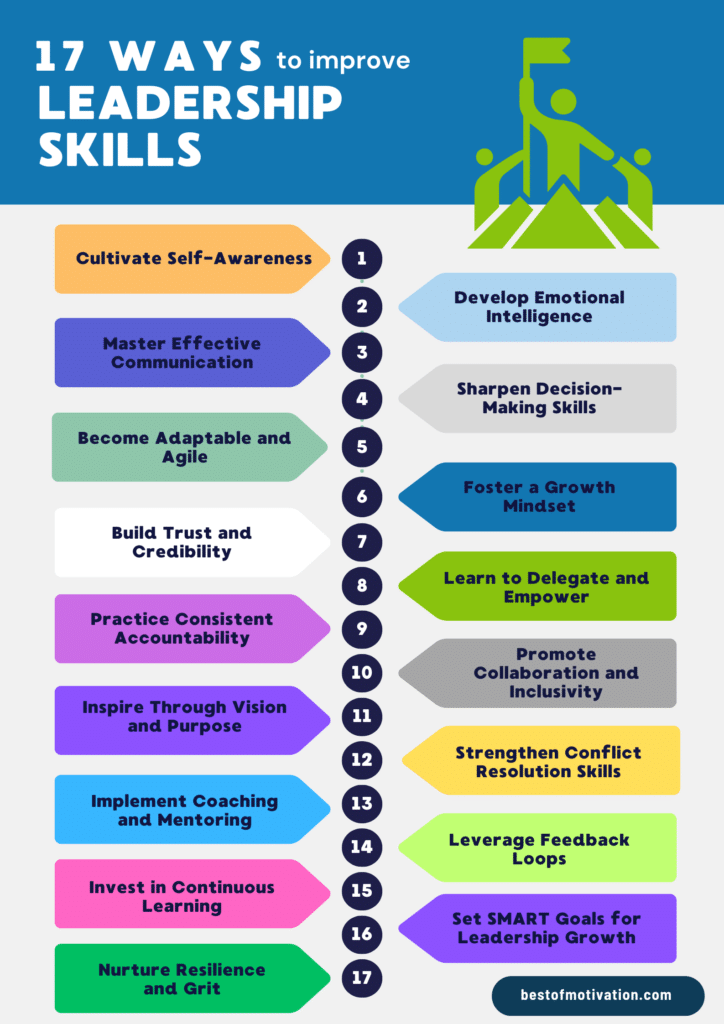
Exercises to Improve Leadership Skills as a Team
Daily leadership journal 5–10 min a day
Write down one moment that tested your leadership, what went well, what could improve and any feedback you got. Builds self-awareness.
Role swap 1 hour a week
Team members swap a task or shadow each other’s role. Builds empathy and a shared view of how the work fits together.
Feedback round 30–60 min every two weeks
Everyone gives one teammate one thing that is working and one thing to try. Makes feedback normal instead of rare.
Conflict practice 30–60 min a month
Small groups work through a made-up conflict, then compare solutions. Builds listening and problem-solving before the real thing.
Frequently Asked Questions About How to Improve Leadership Skills
How long does it take to improve leadership skills?
Some skills, like clear communication or delegation, show results within a few weeks of deliberate practice. Deeper abilities such as emotional intelligence take months. Practising two skills at a time for a month each is a realistic pace.
Do I need a management role to develop leadership skills?
No. You can develop leadership skills at any level by taking initiative, mentoring a colleague, supporting teammates or leading a small project. These are often the experiences that lead to a management role.
How do I overcome imposter syndrome while growing as a leader?
Imposter syndrome is common, even among experienced leaders. Keep a short record of your wins, ask for specific feedback, and remember that leadership is practised, not inherited.
Can introverts improve their leadership skills?
Yes. Introverts often bring strengths in deep thinking, empathy and active listening, which make for very effective leadership. The aim is to lead in your natural style, not to copy a louder one.
Can AI help me improve my leadership skills?
Yes, as a preparation partner. AI can help you plan a difficult conversation, rehearse it, and turn meeting notes into actions. It cannot build trust or read the room for you, so use it to prepare and keep the conversation itself human.
What can I do if my company offers no leadership training?
Leadership growth does not depend on formal programmes. Online courses, books, podcasts and peer-learning groups all help you develop leadership skills on your own schedule.
Where to Start
None of this needs a new job title. Pick two of the seventeen, practise them for a month, and notice what changes in how people respond to you. Then pick the next two. Leadership compounds the same way savings do: small deposits, made consistently, over a long horizon.
Pick your starting point by the gap you notice most
- Feedback keeps surprising you → start with self-awareness (1). You cannot fix what you cannot see.
- Meetings run long and nothing lands → communication (3). Fewer words, clearer asks.
- You do everything yourself → delegation (8). Your team cannot grow on tasks you keep.
- Decisions stall for weeks → decision-making (4). Decide with what you have, then adjust.
- The team avoids hard conversations → conflict resolution (12). Early and calm beats late and loud.
- You are running on empty → resilience (17). Nobody leads well tired.
- Prep eats your week → the AI bonus (18). Let it draft; you decide.
Most people read a guide like this, nod, and change nothing. The ones who improve are the ones who choose a starting point before they close the tab. That is the whole difference.
Free download: the Weekly Leadership Planner (Word document) gives you one page a week to plan the two or three strategies you are working on.
If you want the plan, not just the list
New to managing? The 90-Day New Manager Accelerator turns the skills above into week-by-week actions: a 22-page guide, a fillable workbook with 1:1 templates, and a wall reference card. 14-day money-back guarantee.
Get the 90-Day Accelerator · £37 →Already leading a team? The Clarity-First Leadership Playbook (£7) is the scripts-and-templates kit for meetings, feedback and difficult conversations.
References and Further Reading
- Gallup, State of the Global Workplace: 2025 Report, 2025.
- Paul J. Zak, “The Neuroscience of Trust”, Harvard Business Review, January–February 2017.
- Center for Creative Leadership, “4 Core Leadership Skills You Need in Every Role”.
- Carol S. Dweck, Mindset: The New Psychology of Success, Random House, 2006.