Share as a reel
Save the videoFor managers
One-on-one meeting questions that get past “all fine”.
Twenty minutes of polite updates, and you still don’t know what’s really going on.

Why it matters
21%
of employees actually meet with their manager every week.
Managers account for 70% of the variance in team engagement.
Workhuman 2024 · Gallup 2025
The whole idea
A 1:1 is their meeting, not your status update.
- 1Their agenda first
- 2One real question
- 3One action each
The 30-minute template
Five blocks. Their part is the biggest.
- 5 minCheck-in
- 10 minTheir agenda
- 5 minFeedback and recognition
- 5 minGrowth and development
- 5 minAction items and close
40+ questions · 8 groups
- Work and progressWhat’s taking more time than it should?
- BlockersWhere do you need help but haven’t asked?
- FeedbackIs there something I should start, stop, or continue doing?
- Forward-lookingWhat would make you leave?
All eight groups are in the template below.
Before you use them
Don’t ask all of these. Pick 2-3 per meeting.
These are starting points, not a checklist. The best 1:1s feel like conversations, not interrogations.
Aim for a 70/30 split: they talk 70%, you talk 30%.
A note from Nelson
“I used to dread 1:1s — they felt like awkward status updates that neither of us wanted to be in. Once I started using a proper structure with real questions, everything changed. My team actually looked forward to them.”
Make it a habit
Polite 1:1s for weeks. Then a problem you hear about last.
An agenda sheet, a first-1:1 script, a 20-question bank and a follow-up tracker for the whole team.
Get the 1:1 Meeting Kit · £7 →The 30-minute one-on-one meeting template that boosts team growth and builds trust.
A ready-to-use 1:1 format with 40+ questions, timing, and best practices. Stop winging your one-on-ones — start having conversations that grow your team.
“I used to dread 1:1s — they felt like awkward status updates that neither of us wanted to be in. Once I started using a proper structure with real questions, everything changed. My team actually looked forward to them. The template below is what I use.”
The one-on-one meeting is the most important meeting on your calendar — and the fastest way to boost team growth. Done well, it’s where trust compounds, blockers surface, feedback lands, and development conversations actually happen. Done badly, it’s a 30-minute status update neither of you wanted to be in.
Gallup’s 2025 research shows only 47% of employees strongly agree they know what’s expected of them at work. Only 31% feel someone encourages their development. Only 28% feel their opinions count. These aren’t engagement problems — they’re conversation problems.
A well-run 1:1 fixes all three. This guide gives you a ready-to-use template, 40+ questions across categories, the best practices that separate good managers from great ones, and answers to the questions new managers ask most.
📋 The 30-minute 1:1 template
1. Check-In 5 min
- “How are you doing — really?”
- “What’s been on your mind this week?”
- “Anything happening outside of work that’s affecting you?”
2. Their Agenda 10 min
- “What do you want to cover today?”
- “What’s your biggest challenge right now?”
- “Is there anything blocking your progress?”
3. Feedback & Recognition 5 min
- “I wanted to acknowledge [specific thing] — it made a real difference.”
- “Here’s something I noticed that you could try differently next time…”
- “Is there any feedback you’d like to give me?”
4. Growth & Development 5 min
- “What skills do you want to develop this quarter?”
- “Is there a project or opportunity you’d like more exposure to?”
- “How can I help you grow in your role?”
5. Action Items & Close 5 min
- “What are you committing to before our next 1:1?”
- “What do you need from me this week?”
- “Is there anything we didn’t cover that we should?”
💬 40+ questions by category
🎯 Work & progress
- What’s going well this week?
- What’s your biggest priority right now?
- What’s taking more time than it should?
- What would make your work easier?
- Is there anything you’re procrastinating on?
🚧 Blockers & challenges
- What’s frustrating you right now?
- Where do you need help but haven’t asked?
- Is anything slowing you down that I could remove?
- What decision are you waiting on?
- What’s the hardest part of your job right now?
🤝 Team & collaboration
- How’s collaboration with the team going?
- Is there anyone you’d like to work with more?
- Are there any team dynamics I should know about?
- Do you feel like your work is visible to others?
- What could we do differently as a team?
📈 Growth & development
- What skills do you want to develop?
- What would your ideal next role look like?
- Is there a project you’d love to work on?
- Do you feel challenged in your current work?
- What’s something you learned recently?
💡 Feedback & recognition
- What feedback would be helpful for you right now?
- Is there something I should start, stop, or continue doing?
- Do you feel recognised for your work?
- What’s the best feedback you’ve ever received?
- How do you prefer to receive feedback?
⚡ Engagement & wellbeing
- On a scale of 1-10, how are you feeling about work?
- What would make that number higher?
- Are you feeling energised or drained lately?
- Is your workload sustainable?
- What’s the best part of your job right now?
🏢 Company & culture
- Do you feel connected to our company goals?
- Is there anything about our culture that concerns you?
- What do you wish leadership knew?
- Do you understand how your work connects to the bigger picture?
- What would make this a better place to work?
🔮 Forward-looking
- What are you excited about for next quarter?
- What are you worried about?
- Where do you see yourself in a year?
- What would make you stay at this company long-term?
- What would make you leave?
✓ Best practices
🔍 Spotting team-growth blockers in your 1:1s
Most 1:1 advice is about the conversation itself — questions to ask, feedback to give, agendas to follow. The advice that’s harder to come by: how to use what you hear in 1:1s to spot what’s silently slowing your team’s growth.
Three patterns to listen for: unevenness (one team member’s workload spikes while another’s is light), overburden (someone running flat-out every week — that’s a sustainability problem, not a productivity win), and waste (work that doesn’t help anyone, repeated handoffs, meetings that should be a Slack message). Lean calls these mura, muri, and muda. Once you hear them in a 1:1, you can fix the work rather than trying to fix the person.
The fastest way to grow your team isn’t more pressure or more pep talks. It’s removing the friction your team has stopped complaining about because they assume that’s just how things are.
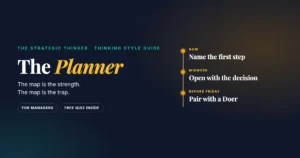
Your approach to 1:1s depends on how you naturally lead. Discover your style and learn how to adapt it for different team members.
Take the free quiz →❓ FAQs managers ask about 1:1s
How long should a one-on-one meeting be?
30 minutes is the sweet spot for most weekly 1:1s. Long enough to go beyond surface-level updates, short enough to stay focused. Move to 45–60 minutes if you only meet biweekly, or for development-heavy conversations. Anything under 20 minutes turns into a status update — which isn’t what a 1:1 is for.
How often should I do 1:1s with my team?
Weekly is the default — Gallup’s data shows 3× higher engagement among employees who get weekly feedback. Biweekly works for senior, autonomous reports. Monthly is usually too infrequent; problems get bigger between meetings and trust doesn’t compound.
How do 1:1s help boost team growth?
A weekly 1:1 is the single highest-leverage activity for team growth because it’s the only meeting designed to surface what’s actually slowing each person down. You hear about blockers earlier, give feedback faster, spot development opportunities sooner, and notice burnout signs before they become resignations.
What’s the difference between a 1:1 and a status meeting?
A status meeting is about the work — what’s done, what’s next, what’s late. A 1:1 is about the person — their challenges, growth, feedback, wellbeing. If you only have time for one, do the 1:1. Status updates can live in async tools; trust and development can’t.
What should I ask in my first 1:1 with a new team member?
Focus on understanding, not directing. Try: “How do you like to be managed?”, “What’s the best feedback you’ve ever received and why?”, “What would make this role a great fit for you?”, “What should I know about how you work that I wouldn’t think to ask?” Save your own expectations for week two.
What if my team member has nothing to discuss?
That’s a signal, not a problem. Try: “What’s one thing making your work harder right now?” or “If we had this same conversation in three months, what would you want to be able to say?” If they still have nothing, use it for development — pull a question from the Growth & Development category in the bank above.
Want this template printable?
The 1:1 Meeting Kit turns it into working tools: an agenda sheet, a first-1:1 script, a 20-question bank and a follow-up tracker for the whole team.