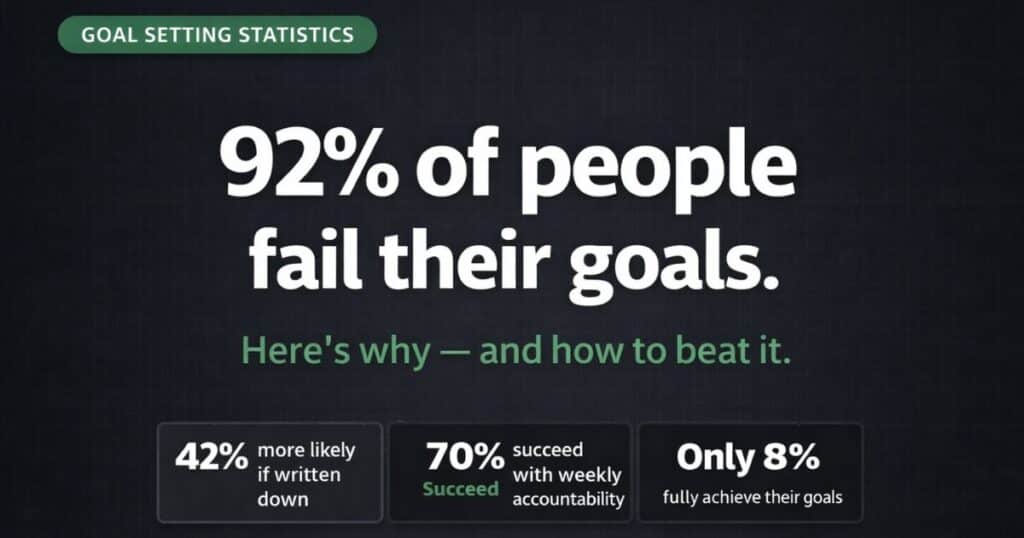
Research suggests that 92% of people who set goals fail to achieve them. (Zippia) That’s a striking number — and it raises an obvious question: if goal setting is supposed to be the foundation of success, why does it fail so often?
The answer isn’t that goal setting doesn’t work. The science is clear — it does. The problem is how most people do it. Vague goals with no written plan, no milestones, and no accountability don’t produce results. The 8% who succeed aren’t more talented or disciplined. They follow a different process.
This article pulls together the most current and well-sourced goal setting statistics — what the research actually shows, where the failure points are, and exactly what separates those who achieve their goals from those who don’t.
Why 92% of Goal Setters Fail
The 92% failure figure comes from research into how people actually behave around goals — not just whether they set them. Three consistent failure patterns show up across studies.
Failure pattern 1: goals without a written plan
Most people set goals in their heads and leave them there. A goal that isn’t written down is closer to a wish than a commitment. The research from Dr. Gail Matthews at Dominican University confirmed this directly — participants who only thought about their goals (without writing them down) achieved the lowest success rates in the study. (Matthews, Dominican University)
Failure pattern 2: vague goals with no milestones
“Get fit.” “Earn more money.” “Grow my business.” These aren’t goals — they’re directions. Research consistently shows that specific, challenging goals outperform vague goals in 90% of studies. (Mooncamp, citing Hey & Pietruschka, 1998) Without a milestone to hit by a specific date, there’s no trigger to act and no way to measure progress.
Failure pattern 3: no accountability structure
The third failure point is attempting goals in isolation. Without someone to report to — a mentor, a peer, a coach, even a written commitment — the social pressure that drives follow-through simply isn’t there. This is the most fixable of the three failure patterns, and the data on what it produces is remarkable.
The Writing Effect: 42% More Likely to Succeed
One of the most replicated findings in goal setting research is the impact of writing goals down. The effect is significant, consistent, and requires almost no extra time.
Dr. Matthews’ study at Dominican University followed 267 participants across five groups with varying levels of goal structure. The group that simply thought about goals (no writing) averaged a goal achievement score of 4.28 out of 10. The group that wrote goals down jumped to 6.08. The difference isn’t subtle — it’s 42%. (Matthews, Dominican University of California)
Why does writing work? Three mechanisms: it forces specificity (you can’t write down “be healthier” without it immediately feeling inadequate), it creates an external reference point you can return to, and it activates a deeper level of cognitive processing than thinking alone.
This principle connects directly to tools like the SMART Goals Generator on BOM — the act of building out your goal in structured form does the cognitive work that most people skip when they keep goals in their head.
The Success Scenario Simulator turns your written goal into a personalised roadmap — milestones, obstacles, and three immediate actions. Free. Takes 3 minutes.
Build My Goal Scenario →Accountability: The Multiplier Most People Skip
Writing goals down doubles your chances. Adding accountability to that nearly doubles them again. The Matthews study found that the group who wrote goals, took action steps, and sent weekly progress updates to a friend achieved the highest success rates of any group — more than 70% reported successful goal achievement. (Dominican University, Matthews)
Compared to 35% for those who kept goals private — accountability more than doubles your success rate. The mechanism is straightforward: social commitment raises the psychological cost of not following through. It turns an internal commitment into an external one.
Three accountability structures that work
The Matthews study showed this produces the highest outcomes. The peer doesn’t need to be an expert — they just need to know your goal and expect an update.
Research shows people are 65% more likely to achieve a goal when they commit to it in the presence of an accountability partner. The higher the stakes of the relationship, the stronger the effect. (ASTD)
Sharing goals publicly — even in a journal or with one trusted person — activates a consistency drive. Once stated, the brain works to align behaviour with the commitment.
Goal Setting Statistics at Work
The research on goals in professional settings is some of the most actionable data available. It shows both the upside of effective goal setting and the scale of the problem when it’s missing.
| Finding | Stat | Source |
|---|---|---|
| Employees with goals are more engaged | 70% more engaged | ZipDo, 2025 |
| Employees with goals more committed to their org | 3.6x more likely to stay | Bi Worldwide, via Mooncamp |
| Goal setting improves corporate performance | Up to 25% improvement | ZipDo, 2025 |
| Workers who don’t understand company goals | 61% of employees | Giodella, 2024 |
| Quarterly goal reviews vs annual reviews | 31% higher returns | Forbes, 2018, via Mooncamp |
| Daily goal setters hit KPI targets | 34% more likely | PwC, study of 12,000 employees |
| Employees who complete daily goals clear work faster | 10% faster ticket resolution | PwC research |
The PwC data is particularly striking — it comes from a study of over 1.5 million goals across 12,000 employees, making it one of the largest real-world goal setting datasets available. The finding that employees who set at least four daily goals per week are 34% more likely to hit their KPI targets isn’t theoretical — it’s drawn from observed workplace behaviour. (PwC)
What SMART Goals Actually Do to Your Results
SMART goals (Specific, Measurable, Achievable, Relevant, Time-bound) are so widely cited that they risk being dismissed as corporate jargon. The data justifies taking them seriously.
The specificity effect
Goal Setting Theory, developed by Edwin Locke and Gary Latham, is one of the most studied frameworks in organisational psychology. Its core finding: specific, difficult goals consistently produce higher performance than vague or easy goals — across more than 1,000 studies spanning 40+ years. (Mooncamp)
The mechanism is attention. Specific goals direct attention toward relevant activities and away from irrelevant ones. When a goal is vague, the brain has no clear signal about what constitutes progress — so it defaults to easier or more familiar activities.
The time-bound effect
Adding a deadline to a goal isn’t just about urgency — it creates a review point. Teams that review goals quarterly generate 31% more returns than those who review annually. (Forbes, 2018, cited in Mooncamp) The deadline forces a moment of honest assessment that vague, open-ended goals never produce.
The Goal Setting Framework That Works
Pulling together everything the research shows, here is the process that moves you from the 92% to the 8%.
State the goal with enough specificity that a stranger could understand it. “Transition into a consulting role within 12 months” is a goal. “Do better at work” is not. Writing adds 42% to your odds before you’ve done anything else. (Matthews, Dominican University)
A 12-month goal needs quarterly checkpoints at minimum. Each milestone should be a concrete deliverable, not an activity. “Have three client conversations by end of month 2” is a milestone. “Start networking” is not.
The biggest predictor of long-term follow-through is whether you take action in the first 72 hours. Every goal needs a “this week” action — something small, concrete, and completable that builds initial momentum.
Weekly progress reports to a peer or mentor add 40% to goal achievement rates. It doesn’t need to be formal — a message, a check-in, or a shared document. The act of reporting is the mechanism.
Quarterly reviews generate 31% higher returns than annual ones. At each review, ask two questions: what’s working that I should do more of? What’s not working that I should change or cut? The goal may need adjusting — that’s not failure, it’s strategy.
Written goal + specific milestones + weekly accountability = the three components that separate goal achievers from goal setters. Each one individually improves results. Together, they shift the odds dramatically in your favour.
The Success Scenario Simulator generates a realistic, AI-powered scenario for your specific goal — milestones, risks, opportunities, and three immediate actions. Free. Takes 3 minutes.
Try the Free Simulator →