
Most retail operations do not have a waste problem they cannot see. They have a waste problem hiding inside the things they accept as normal — the extra walk to the stockroom that nobody questions, the safety stock that quietly doubles, the checkout error that triggers a 20-minute return process. It is all just part of the job.
Taiichi Ohno, who built the Toyota Production System, gave that normalised friction a name: muda — the Japanese word for waste. He identified seven distinct categories of it, and every single one of them shows up on a shop floor. If you lead a retail operation and you have never mapped your processes against them, there is a good chance a meaningful share of your team’s time and your business’s margin is disappearing into that gap.
This guide applies muda thinking directly to retail — not in theory, but in the situations your team faces every shift. Each of the seven wastes gets a real retail example and a concrete fix you can act on without a six-month transformation programme.
Why retail leaders should care about waste
Lean thinking began on manufacturing lines, and for decades it stayed there. Retail borrowed the vocabulary occasionally — “five S”, “kaizen events” — but rarely applied the discipline to its own flows. That is changing. Retailers under margin pressure, with tighter headcount and rising customer expectations, no longer have the luxury of normalising inefficiency.
The three Ms of Lean — Mura, Muri, and Muda — work together. Muda (waste) is often the visible symptom of Mura (unevenness in workload or process) and Muri (overburden on your people). Strip out the waste and you almost always find a process that was straining your team quietly for months.
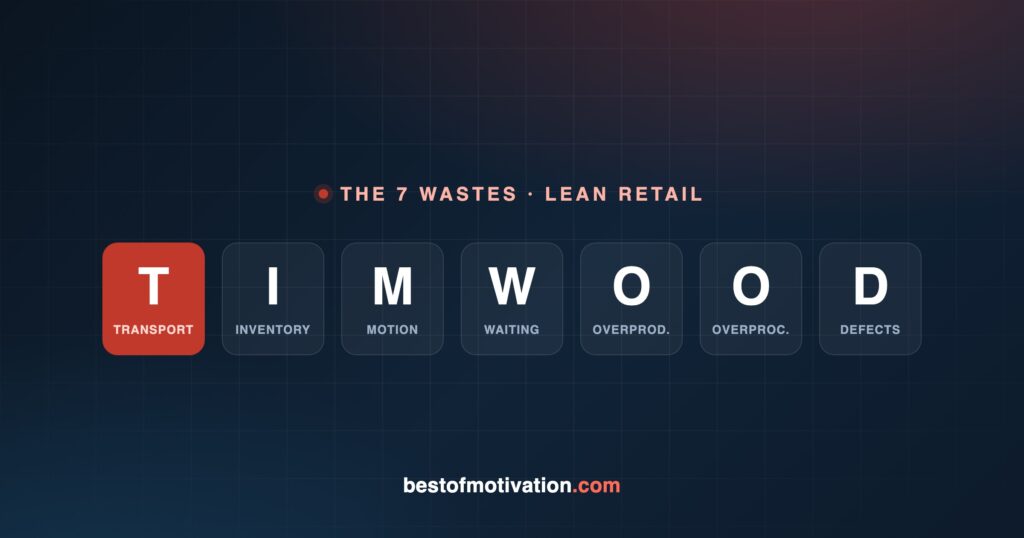
The seven wastes are remembered by the acronym TIMWOOD: Transport, Inventory, Motion, Waiting, Overproduction, Overprocessing, Defects. Ohno considered overproduction the most dangerous because it generates or disguises all the others. In a retail context the ranking shifts slightly — but the principle holds.
TIMWOOD — the 7 wastes at a glance
- T Transport Products taking too many trips
- I Inventory Stock tying up cash and space
- M Motion People walking more than needed
- W Waiting Idle time from upstream delays
- O Overproduction Prepared before it is needed
- O Overprocessing Steps the customer would not pay for
- D Defects Errors needing rework or apology
The 7 wastes in retail: a practical breakdown
Transport: unnecessary movement of products or information
Transport waste is any movement of goods that does not directly serve the customer. In retail, the classic version is a product that travels: from the delivery vehicle to the goods-in area, then to a bulk storage location, then to the stockroom, then to the shop floor, then — because it was placed in the wrong bay — back to the stockroom. That is five moves. A well-designed layout needs two.
- A product touches five or more locations before reaching the shelf
- Goods are moved to bulk storage and then moved again to the stockroom before going out
- Information chains have three or more handoffs before a decision is made
- Walk the goods-in-to-shelf route and count every handoff
- Map the ideal route — usually two moves or fewer
- Reorganise the physical space to enable direct, uninterrupted flow
Inventory: holding more stock than the process needs
Excess inventory is retail’s most visible and most defended waste. The case for it always sounds rational: “We need that buffer because supply is unpredictable.” Sometimes that is true. More often, the buffer grew organically over years of cautious ordering and nobody ever challenged it because the stockroom was already there.
- Stock that is not moving ties up cash and occupies space
- Eight or more weeks of a product on hand when demand is stable
- Replenishment inconsistencies hidden by the buffer — errors invisible until stock runs out
- Run an ABC analysis: fast-moving (A), moderate (B), slow or seasonal (C)
- Set a maximum holding quantity for each tier
- Build a replenishment rhythm matched to real demand, not historic habit
Motion: unnecessary movement of people
Motion waste is distinct from transport waste. Transport is about products moving; motion is about people moving. It is exhausting in a way that does not show in the output figures — it contributes quietly to the fatigue that erodes service quality and engagement over an eight-hour shift.
- The checkout operator walks to the back office three times per shift to get change
- The section manager visits three separate areas to find the handheld scanner
- Daily-replenishment items stored at the top of the stockroom, requiring a ladder
- Do a frequency-of-access audit: daily items go at the most accessible height, nearest the floor exit
- A 5S sort and set-in-order exercise takes an afternoon with no capital investment
- Create a fixed home for shared tools (scanners, floats) so searching is eliminated
Waiting: idle time caused by upstream process failures
Waiting waste happens when a person or process cannot proceed because something else has not arrived, been completed, or been communicated. Customer-facing waiting waste is double-sided: it costs idle labour time and customer experience simultaneously. The customer who waits 90 seconds at an unstaffed counter and then leaves has already made a decision about whether to return.
- Refunds requiring manager approval that company policy could authorise automatically
- Queue building at one till while two others sit closed because nobody is trained to open them
- Team member unable to answer availability questions because system access is back-office only
- List your top five recurring approval points and ask: does this genuinely need a manager?
- Resolve each with a clear policy, a wider authorisation level, or a system change
- Multi-skill across till, floor, and stockroom so the operation flows without any single person
Not sure where waste is hitting your operation hardest?
The BOM Lean Operations Diagnostic takes 90 seconds and scores your operation across Muda, Mura, and Muri — with a personalised action report.
Take the free Lean Diagnostic →Overproduction: doing more than what is needed, before it is needed
Ohno called overproduction the worst of the seven wastes because it is the one that creates all the others. In a manufacturing context it means making products nobody has ordered. In retail, the equivalent is preparing more than the customer or the operation requires — at that moment. Overproduction is often a management response to uncertainty: “better to have it ready than not” — but it typically creates the same problems it was designed to prevent.
- Promotional display built three days early and having to be rebuilt the night before launch
- Bakery preparing the same volume on a quiet Tuesday as on the Saturday peak
- Fulfilment team picking and packing before the carrier has capacity to collect
- Build pull-based triggers: a shelf level, a pick queue threshold, or a footfall-aligned time signal
- Replace “prepare X at start of shift” with “prepare when the trigger fires”
- Align preparation volumes to recent demand data, not instinct or historic habit
Overprocessing: doing more work than the customer values
Overprocessing waste is the trickiest of the seven because it often looks like quality. It is the triple-checking of a till count already verified by the system. It is the 600-word weekly report when the operations director reads only the summary table. It is the opening checklist that has accumulated 47 items over five years because nobody ever removed a step, only added them. The test is simple: would the customer pay for this step if they knew it existed? If the honest answer is no, it is a candidate for elimination.
- Checklists longer than 20 items that nobody ever challenges
- Quality inspections duplicated at goods-in, at pick, and again at despatch
- Reporting that takes longer to produce than it takes the reader to read
- For each process-heavy task, ask: what decision does this information support?
- Identify the minimum accurate version that supports that decision — cut or merge the rest
- Review every six months; processes accumulate by default
Defects: errors that require rework, correction, or apology
Defects in retail take many forms: the wrong price applied to a product at the shelf, triggering a customer complaint and a price override at the till; the mispick in an online order that generates a return, a redelivery, and a customer service contact; the incorrectly filled shelf that creates a phantom out-of-stock and loses a sale. Each defect has a direct cost — the correction — and an indirect cost that is usually larger: the erosion of customer trust and the distraction of the leader who has to manage the fallout instead of developing the team.
The Lean approach is to design processes that make errors difficult to make and easy to spot quickly — what Toyota calls poka-yoke, or error-proofing. The goal is not zero tolerance for human error; it is a system that catches errors at the point of origin rather than three steps downstream.
- Wrong price on shelf triggers customer complaint and override at the till
- Mispick in online order generates return, redelivery, and a customer contact
- Incorrect shelf fill creates a phantom out-of-stock and loses a sale
- Trace each frequent defect to its point of origin: what made the mistake easy to make?
- Introduce a visual control, confirmation step, or checklist at that single point
- Do not add inspection at the output end — inspect at the source; it is faster and builds quality in
The bonus: an 8th waste most retail leaders overlook
Unused human talent and potential
When Lean thinking spread from Toyota’s production lines to Western organisations in the 1990s, practitioners added an eighth waste: the underuse of people’s skills, knowledge, and ideas. The TIMWOOD acronym became TIMWOODS.
- The experienced team member who knows a better replenishment sequence but has never been asked
- The multilingual colleague whose language skills are invisible on the rota
- The supervisor with natural coaching ability spending their shift on admin a junior could handle
- Build a simple skills and interests map — not an HR process, just a conversation
- Ask what each person does well that the team is not using, and what they would like to own
- Match hidden capability to operational needs — building that leadership habit early is one of the highest-return investments a retail manager can make
Skills waste is the only waste that is entirely self-inflicted. It does not come from a supply chain, a system, or a seasonal fluctuation. It comes from a leadership culture that values compliance over contribution.
How to run your first waste walk
Theory is useful. A walk is better. The waste walk — sometimes called a Gemba walk in Lean practice — is the act of going to the place where the work actually happens, observing it without a script, and asking: what is slowing this down, and what is the team working around?
A structured approach to Kaizen practices gives you the framework to sustain these observations beyond a one-off exercise. The waste walk is the start; the improvement cycle is what turns the observation into a permanent change.
For a first waste walk in a retail environment, keep it focused:
Step one: pick one flow
Choose a single process — goods receipt, morning replenishment, end-of-day close, online order pick and pack. Do not try to observe the whole operation at once. One flow, one session.
Step two: observe without intervening
Watch the process run as it normally does. Note every time a person stops, waits, doubles back, searches for something, or corrects an error. Note the time each interruption takes. Do not fix anything yet.
Step three: count the wastes
At the end of the observation, map what you saw against the seven categories. Which types appeared most frequently? Which had the highest time cost? That is your priority list.
Step four: pick one waste to address first
The most common mistake in process improvement is trying to fix everything at once. Pick the single biggest waste by time cost, involve the people who do the work in designing the fix, and implement a trial. Measure the result. Then move to the next one.
The core principles of Lean management always point in the same direction: start with value, find the waste, flow without interruption, pull from the customer back. The waste walk is where all of that becomes tangible.
Lean is not a project — it is a leadership posture
The most important thing to understand about the 7 wastes is that identifying them is not the hard part. The hard part is maintaining the discipline to keep looking for them after the initial improvement buzz fades.
Organisations that sustain Lean do so because their leaders hold the standard. They ask the waste question on every process review. They reward the team member who spots an inefficiency — not the one who heroically works around it. They treat a smooth, waste-free operation not as a cost programme but as evidence that the team has more capacity for the things that actually grow the business.
“All we are doing is looking at the time line from the moment the customer gives us an order to the point when we collect the cash. And we are reducing that time line by removing the non-value-added wastes.” — Taiichi Ohno, Toyota Production System (Productivity Press, 1988)
That time line exists in every retail operation. The customer walks in — or clicks — with a need. Your job is to get from that moment to a satisfied customer with as little friction as possible. Every waste in the TIMWOOD framework is friction. Some of it is structural, some of it is behavioural, and some of it has simply never been named. Naming it is the first step.
Find out where your operation is leaking time and margin
The BOM Lean Operations Diagnostic scores your retail or hospitality operation across all three pillars of waste — Muda, Mura, and Muri — and generates a personalised 30-day improvement plan.
Take the free Lean Diagnostic (90 seconds) →Frequently asked questions
What are the 7 wastes of Lean in a retail context?
The 7 wastes — identified by Taiichi Ohno as part of the Toyota Production System and captured in the acronym TIMWOOD — are: Transport, Inventory, Motion, Waiting, Overproduction, Overprocessing, and Defects. In a retail setting, each manifests as a specific operational friction: unnecessary product movements between stockroom and shop floor, excess safety stock that ties up cash, team members walking further than necessary to retrieve items, customers waiting because a process requires manager approval, preparation ahead of actual demand, over-elaborate reporting or inspection steps, and errors that require rework such as mispicks or pricing mistakes.
Which of the 7 wastes causes the most damage in retail?
Ohno identified overproduction as the most harmful because it tends to generate or conceal all the other wastes. In a retail context, waiting waste and defects often carry the most immediate customer-facing cost, as they directly affect service quality and the chance of a repeat visit. That said, the ranking matters less than identifying which waste is largest in your specific operation — which is why a waste walk or a structured diagnostic is always preferable to a generic priority list.
What is the 8th waste in Lean, and why does it matter in retail?
The 8th waste — added when the Toyota Production System was adapted for Western service and knowledge-work environments — is the underuse of human talent and skills (sometimes called “skills waste” or “intellect waste”). In retail it appears as experienced team members whose knowledge is never tapped, colleagues with capabilities the operation needs but has never identified, and a general culture of task completion over contribution. It is the only waste that leadership can eliminate entirely through management behaviour rather than process redesign.
How do I start applying Lean thinking to my retail store without a formal programme?
The simplest entry point is a waste walk: choose one process (goods receipt, replenishment, customer returns), observe it running without intervening, and map what you see against the 7 waste categories. Note how often each type appears and roughly how long each instance takes. Pick the single biggest waste by time cost, involve the people who do the work in designing a fix, trial it, and measure the result. That is a complete Kaizen cycle, and it requires no external consultants, no budget, and no transformation programme.
Is Lean applicable to e-commerce fulfilment as well as physical stores?
Yes. The 7 wastes translate directly to fulfilment operations: transport waste appears in pick-path inefficiency, inventory waste in overstock held in the fulfilment centre, motion waste in poorly organised pick locations, waiting waste in batched processing that delays despatch, overproduction in packing orders before carrier capacity is available, overprocessing in duplicate quality checks, and defects in mispicks and damaged items. Lean and the waste framework originated in high-volume repetitive processes — fulfilment is arguably a closer analogue to manufacturing than a traditional shop floor is.