
A career change at 40 feels different from one at 25 — and not in the way most people assume. You are not behind. You are carrying two decades of judgement, a clearer sense of what drains you, and a network you didn’t have the first time around. The fear is real, but so is the evidence: people who pivot in their 40s and 50s often see some of the strongest outcomes of any age group. This guide is the practical version — what to assess, how to plan it, and how to manage the money side without taking a reckless leap. It builds on our wider guide to planning a career change, focused on what changes when you do it at 40.

Is 40 Too Late for a Career Change?
No — and the data is on your side. The idea that careers are fixed by your 40s is a holdover from an era when people stayed at one employer for life. That era is gone. According to the U.S. Bureau of Labor Statistics, median job tenure is now 3.9 years — the lowest since 2002 — and workers hold around 12 jobs across a working life.
The fear at 40 usually isn’t really about age. It’s about responsibility — a mortgage, dependents, a salary you can’t easily walk away from. That’s legitimate, and we deal with it directly in the money section below. But “too late” is the wrong frame. Workers in the 45–54 bracket make up a smaller share of career changers, yet the ones who do change report among the strongest outcomes. You can see the full breakdown in our career change statistics roundup.
| What people fear at 40 | What the evidence shows |
|---|---|
| “I’m too old to start over” | ~80% of career changers report being happier in their new field |
| “I’ll never recover the income” | 77% recover their income within two years of transitioning |
| “Employers want younger people” | 26% average salary increase is typical when people change jobs deliberately |
| “It’s an irresponsible risk” | The risk is real but manageable — the section below shows how |
Sources: career-changer happiness and income-recovery figures via Apollo Technical and FlexJobs; salary-change data via the U.S. Bureau of Labor Statistics. See the fully referenced breakdown in our career change statistics roundup.
What You Have at 40 That You Didn’t at 25
A 25-year-old changes careers on potential. You change on proof. That difference is an asset, not a liability — once you learn to frame it.
Three advantages that compound in your 40s
Transferable skill, not raw skill. Twenty years of work leaves you with judgement, communication, and the ability to manage people and projects. Those skills move between industries far more easily than technical ones. Your job is to translate them, not rebuild from scratch.
Self-knowledge. You now know what kind of work energises you and what quietly burns you out. A younger person is still guessing. That clarity shortens the search — you are filtering, not exploring blind.
A real network. Two decades of colleagues, clients, and contacts is a hiring channel younger changers simply don’t have. Most mid-life pivots happen through someone you already know, not a job board.
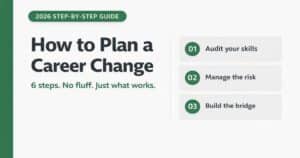
The 5-Step Plan for a Career Change at 40
A career change at 40 works best as a staged transition, not a single leap. Each step lowers the risk before you commit to the next one.

Audit what drains you vs. what you want to keep
Before chasing a new field, get specific about the current one. List what frustrates you and what you’d happily keep. Often the problem is the role or the environment, not the whole industry — and that’s a much smaller, cheaper change to make.
Map your transferable skills onto target roles
Pick two or three directions and ask, for each, “what do I already have that this needs?” If you can’t answer the question, you don’t know the role well enough yet — which leads to the next step. Not sure where to aim? Our What Career Suits Me? quiz is a fast way to surface directions that fit your strengths.
Test before you commit
Don’t quit to find out. Shadow someone in the field, take on a freelance project, volunteer, or run it as a side hustle first. A few weeks of real exposure tells you more than months of research — and it keeps your income intact while you learn.
Close the skills gap deliberately
You rarely need a new degree. Targeted certifications and online courses close most gaps faster and cheaper. Pick the one credential the role actually asks for — not five “nice to haves.” Our roundup of the best online courses for adults is a useful starting point.
Activate your network and reframe your story
Tell the people who already know your work what you’re moving toward. Rewrite your CV and LinkedIn around the new direction, leading with transferable wins rather than a job-by-job history. To sidestep age bias, drop graduation dates and roles older than 15 years, and foreground recent, relevant results instead. At 40, a warm introduction beats a cold application almost every time.
🎯 Take the free 2-minute career quiz
Prefer a full plan on paper? The Career Roadmap (£7) turns these five steps into a guided worksheet.
Best Career Changes to Make at 40
The strongest pivots in your 40s lean on experience rather than competing with 22-year-olds on raw output. Roles that reward judgement, trust, and people skills tend to favour you, not work against you.
| If you’re coming from… | Pivots that use what you already have | Typical US median pay |
|---|---|---|
| Operations / admin | Project management, operations consulting, training & enablement | $95,000+ (project manager) |
| Sales / customer-facing | Account management, customer success, partnerships | $60,000–$90,000 |
| Hands-on trades or technical | Estimating, supervision, technical training, inspection | $65,000–$80,000 |
| Corporate generalist | People & HR management, L&D, internal communications | $130,000 (HR manager) |
| Any field, want autonomy | Consulting or coaching in your existing domain, freelance services | Varies — rate-based |
Median pay figures are indicative US national medians via the U.S. Bureau of Labor Statistics Occupational Outlook Handbook; actual pay varies by region, sector and seniority.
Other well-paid pivots that reward maturity rather than punish it include healthcare administration (~$104,000), registered nursing (~$81,000), technical or UX writing, and data or business analysis — all reachable through a focused certification rather than a second degree.
Notice the pattern: each move treats your 20 years as the raw material, not baggage to apologise for. The clearest pivots are adjacent — one step sideways into where your experience is rare, rather than a complete reset into a field where you’d be a true beginner.
How to Manage the Money Side
This is the real blocker, not age. Around 56% of people name financial risk as the main reason they don’t change careers, and roughly 90% say financial pressure has kept them in a job longer than they wanted (career change statistics, citing CVwizard and High5Test). So treat the money as the first design constraint, not an afterthought.

A lower-risk financial approach
Build a transition runway. Aim for a cash buffer before you move — enough to cover the gap between leaving and earning at the new level. The bigger the buffer, the calmer your decisions.
Overlap, don’t leap. Earn from the new direction as a side income before it becomes your only income. By the time you switch fully, it’s already proven.
Separate “pay cut” from “pay path.” A short-term dip is not a permanent loss — remember that most changers recover income within two years and many end up ahead. Judge the move on the two-year trajectory, not month one.
Mistakes to Avoid
Leaping without testing. Quitting to “figure it out” turns a manageable change into a high-stakes gamble. Test first, every time.
Chasing a passion with no market. Enjoying something isn’t the same as being able to earn from it. Validate demand before you retrain.
Hiding your experience. Don’t write yourself down to look like an entry-level candidate. Lead with the judgement and results only someone with your years can offer.
Collecting credentials to delay. Endless courses can be procrastination in disguise. Get the one credential the role needs, then start applying.
A career change at 40 is not starting from zero — it’s starting from experience. Stage the transition, protect your income while you test, and lead with the judgement that two decades gave you. That’s not a disadvantage to overcome. It’s the reason this works.
If you’re ready to find a direction that fits what you’ve already built, start with the quiz — it’s the fastest way to turn “I want a change” into a shortlist worth testing. For the bigger picture on timing and process, return to our complete guide to planning a career change.
🎯 Find your direction — take the free quiz
Want it mapped out step by step? Get the Career Roadmap (£7).
Frequently Asked Questions
Sources
- U.S. Bureau of Labor Statistics — Employee Tenure Summary (median job tenure)
- U.S. Bureau of Labor Statistics — Number of Jobs Held in a Working Life
- Best of Motivation — Career Change Statistics (aggregated and fully referenced: Apollo Technical, FlexJobs, CVwizard, High5Test)