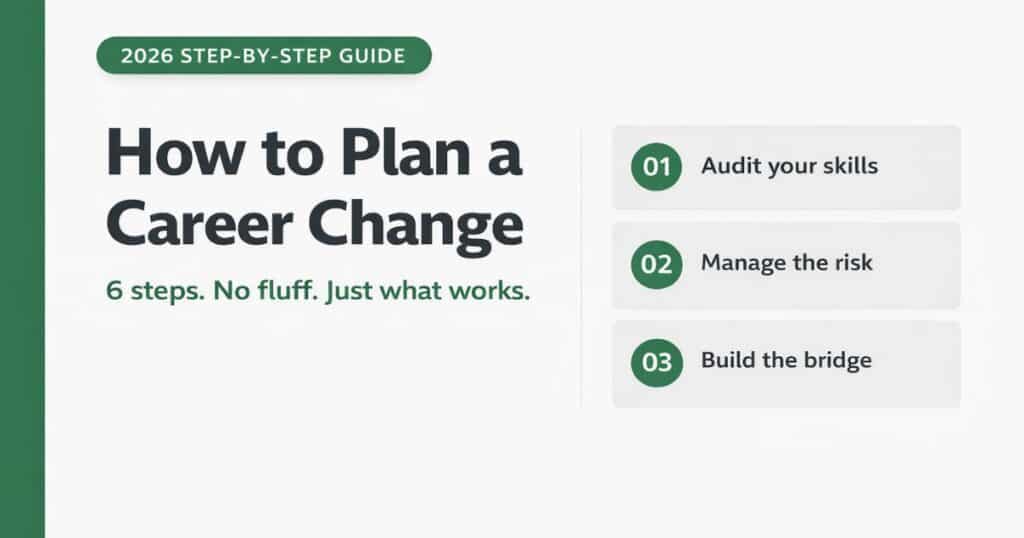
Most career change advice tells you what you already know — “update your CV,” “network more,” “follow your passion.” It’s not wrong, it’s just incomplete. What it skips is the order of operations: the specific sequence of decisions and actions that separates a successful transition from one that stalls after three months of LinkedIn scrolling.
This guide lays out exactly how to plan a career change in 2026 — from the initial skills audit to managing financial risk to landing your first role in the new field. Every step is grounded in current research and practical reality. No generic advice.
- Step 1 — Audit your transferable skills
- Step 2 — Clarify your direction (before you research roles)
- Step 3 — Research your target field properly
- Step 4 — Manage the financial risk
- Step 5 — Build your bridge before you jump
- Step 6 — Rebrand your experience for the new field
- Realistic career change timelines
- Frequently asked questions
Most people begin a career change by looking outward — browsing job boards, reading about other industries, asking “what should I do next?” The more effective starting point is looking inward. What do you already do well that crosses industry lines?
With 85% of employers using skills-based hiring, the question is no longer “do you have the right job title?” — it’s “do you have the right capabilities?” The skills that cross industries most reliably include:
| Transferable skill | Why it travels | Where it’s especially valued |
|---|---|---|
| Communication | 98% of employers require it in new hires | Management, consulting, sales, healthcare |
| Leadership | Drives team performance in any context | Operations, project management, non-profit |
| Analytical thinking | Ranked #1 core skill by employers in 2025 | Finance, tech, strategy, research |
| Project management | Every industry runs on projects | Construction, tech, events, consulting |
| Adaptability | Top hiring signal for career changers | Start-ups, fast-growth sectors, AI roles |
| Problem-solving | Valued above technical skills in most surveys | Operations, product, customer success |
How to run your own skills audit:
- List your last 3 roles and write 5 things you did well in each
- Identify the underlying skill behind each item (not the task — the capability)
- Find 5–10 job descriptions in your target field and highlight repeated requirements
- Cross-reference: where do your skills match their requirements? That’s your transferable foundation
- Note where there are gaps — these become your targeted upskilling list
One of the most common career change mistakes is researching roles before clarifying what you actually want from work. You end up evaluating options against unclear criteria — and the result is paralysis or a move that solves the wrong problem.
Before you look at job boards, answer these four questions honestly:
- What am I leaving behind? Be specific — is it the hours, the culture, the lack of growth, the type of work, or the people?
- What do I want more of? Autonomy, impact, creativity, income, stability, people-facing work?
- What constraints am I working within? Financial runway, location, family commitments, time available for retraining?
- What would “better” actually look like in 12 months? Not a job title — a day-in-the-life description.
This last question is more powerful than it sounds. If you can describe a better working day in concrete terms — the type of problems you’re solving, who you’re working with, what the environment feels like — you have a filter for evaluating every option you’ll encounter.
The Success Scenario Simulator builds a personalised AI roadmap for your specific transition — milestones, risks, hidden opportunities, and your first week action. Free. Takes 3 minutes.
Build My Career Change Scenario →Most career changers research their target field by reading articles and browsing job postings. That gives you a surface-level picture. The research that actually informs a good decision comes from people already in the field.
The informational interview is the most underused tool in career change planning. A 30-minute conversation with someone doing the job you’re considering tells you more than ten hours of online research. Ask about:
- The realities of the role day-to-day vs how it’s marketed
- What background they see working well for people who transition in
- The fastest way to build credibility in the field without years of experience
- What they’d do differently if they were making the move today
What to look at in job descriptions: Don’t just read them — analyse them. Look at 15–20 postings in your target area and note which requirements appear in 80%+ of them. Those are the non-negotiables. Requirements that appear in 20–30% are the differentiators. Focus your upskilling on the non-negotiables first.
In 2026, micro-credentials and certifications carry more weight than they did five years ago. Nearly a third of employers already recognise digital badges in hiring decisions. (TieTalent, 2026) A targeted 3-month certification in your target field often does more to signal intent than a second degree that takes 2 years.
Step 4 — Manage the Financial Risk
Financial risk is the #1 stated barrier to career change, cited by 56% of people considering a switch. (CVwizard, 2025) The good news is it’s manageable — but it requires planning before you move, not after. One of the most reliable ways to build that runway is to start a side hustle alongside your current role — it cushions the income gap and lets you test a new direction before you commit.
The financial risk plan has three components:
Aim for 3–6 months of living costs saved before making a full transition. This isn’t just security — it gives you the confidence to wait for the right opportunity and negotiate properly, rather than accepting the first offer out of financial pressure.
Calculate the minimum salary you can accept and still cover your commitments. This is a firm number, not a preference. Many career changers accept the first offer because they haven’t run this calculation — and spend the next year resenting the decision.
Freelance platforms, fractional roles, and consulting work in your target field let you earn while building experience. Three to six months of documented freelance work in your new field changes your narrative from “career changer” to “experienced hire.” (TieTalent, 2026)
If you want to put real numbers behind the financial-risk thinking above, the Financial Calculators are the fastest way to do it — savings, budget and 5–10-year projection tools. Five minutes there will tell you exactly how long your runway is, what monthly burn the change can absorb, and which month you stop being underwater.
The most successful career changers don’t make a single leap — they build a bridge of overlapping experience that connects where they are to where they’re going. This approach dramatically reduces both financial risk and the credibility gap that holds most career changers back.
Bridge-building options ranked by impact:
- Freelance or consulting work in your target field while still employed — documented experience that holds up in interviews
- A bridge role that overlaps your current skills with the new industry — not ideal, but dramatically lower risk than a full cold-jump
- Volunteer or pro bono work — especially effective in non-profit, tech, and creative sectors where work samples matter more than job titles
- Targeted certifications — a 3-month Google Career Certificate or equivalent signals serious intent to hiring managers
- Contributing to open-source or community projects — particularly relevant for tech transitions where a GitHub profile can outweigh a CV
You’re not starting over. You’re repositioning. The same experience that reads as “20 years in retail management” to one employer reads as “20 years building high-performing teams, managing complex operations, and driving commercial results” to another. The facts don’t change — the framing does.
In 2026, hiring managers care less about what you used to do and more about what you can do now. (Career Agents, 2025) Three things make this reframing work:
- Lead with outcomes, not activities. “Managed a team” is an activity. “Built a 25-person team that reduced staff turnover by 30% over two years” is an outcome. Outcomes translate across industries; activities don’t.
- Use the language of the target industry. Read job descriptions in your target field until you can identify the vocabulary — then use those words to describe your existing experience where they genuinely apply.
- Build a portfolio or case study. For fields where work samples matter (tech, design, consulting, content), a documented project or case study in the new area matters more than a revised CV title.
The 17 proven leadership strategies on BOM are particularly useful here — the competencies of effective leadership (communication, delegation, decision-making, team development) are among the most portable skills in any career transition.
Realistic Career Change Timelines
One of the most damaging things career change content does is imply the process is faster than it is. Here’s what the research and practitioner experience suggests for each transition type.
Input your goal, choose your pathway, and get a personalised AI scenario — milestones, risks, and three immediate actions. Free. Takes 3 minutes.
Try the Success Scenario Simulator →Frequently Asked Questions
Keep Going
Build your roadmap — What Is a Career Roadmap? (And How to Build One Fast).
See the numbers — Career Change Statistics 2026: What the Data Says.
Learn to protect your time during transitions — The Art of Saying No.
Find your direction — Take the Career Growth Quiz.