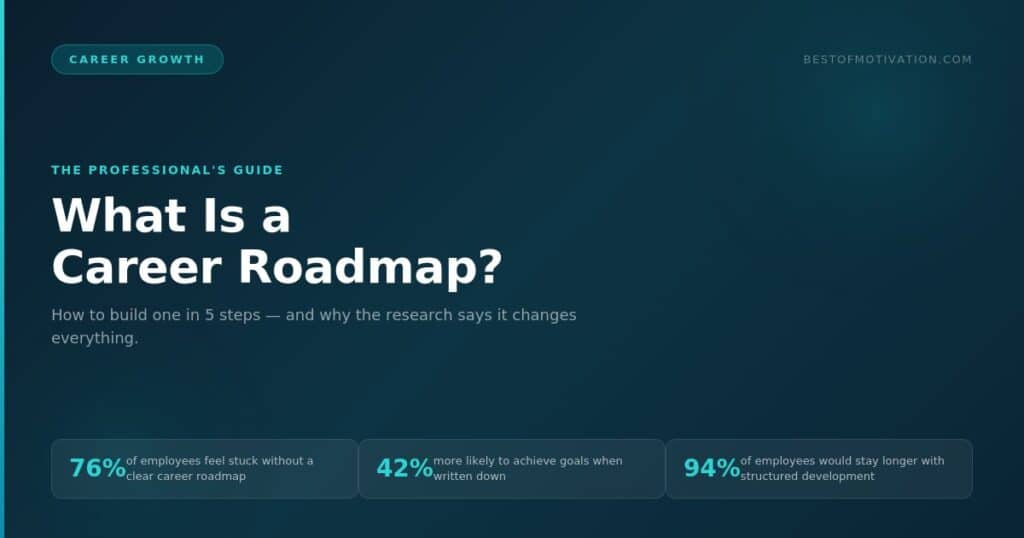
- 76% of employees are actively seeking career growth but feel stuck without a clear roadmap
- Employees with a structured career plan are 3.6× more likely to stay committed to their organisation
- 94% of employees would stay longer at a company that invested in their development
- Organisations investing in career development report 11% greater profitability and are twice as likely to retain staff
- A career roadmap can be built in under 30 minutes using a 5-step framework
A career roadmap is a strategic plan that maps where you are now, where you want to go professionally, and the specific milestones, skills, and actions needed to get there. It’s the difference between drifting through your career and directing it.
Most professionals have a vague sense of where they’d like their career to go. Very few have written it down with a clear sequence of steps. That gap — between knowing what you want and having a plan to reach it — is exactly what a career roadmap closes.
This article covers what a career roadmap actually is, how it differs from a career plan or career path, why the research says it matters, and a five-step process for building one quickly. There’s also a real example you can use as a template.
What Is a Career Roadmap?
A career roadmap is a personalised, written plan that maps the route from your current position to your desired professional destination. It identifies the roles, skills, milestones, and timelines that connect where you are to where you want to be — and it’s flexible enough to adapt as circumstances change.
Think of it as a professional GPS. A GPS doesn’t just tell you the final destination — it shows you the current position, the next turn, and recalculates when the route changes. A career roadmap does the same thing for your working life.
Unlike a wish list or a vague ambition, a career roadmap is:
- Written down — not just held in your head
- Time-bound — with specific milestones and target dates
- Skill-mapped — identifying what you need to develop, not just what you want to achieve
- Revisable — updated as your situation, goals, or the market changes
- Action-oriented — with a clear “next step” at every stage
Career Roadmap vs Career Plan vs Career Path
These three terms are often used interchangeably but they mean different things. Understanding the distinction helps you use each tool for the right purpose.
| Term | What it is | Who drives it | Time horizon |
|---|---|---|---|
| Career path | The typical progression of roles within a field or organisation — often defined by the employer | Largely organisation-driven | Long-term, often linear |
| Career plan | A broad document outlining your professional goals, values, and development priorities | Individual-driven | 3–5+ years |
| Career roadmap | A specific, milestone-based action plan connecting your current position to a defined goal | Individual-driven | Typically 6 months–3 years |
The key differentiator of a career roadmap is its specificity. A career plan tells you what you want. A career roadmap tells you how to get there — with dates, skill gaps identified, and actions sequenced.
Why Career Roadmaps Matter: What the Data Says
The case for having a career roadmap isn’t just intuitive — it’s backed by consistent research on goal setting, employee engagement, and retention.
The data on written goals is particularly relevant here. Research by Dr. Gail Matthews at Dominican University found that people who write down their goals are 42% more likely to achieve them. (Dominican University) A career roadmap is, at its core, a written goal structure — which means the act of creating one immediately improves your odds of reaching the milestones in it. The full picture is in the goal setting statistics — the data on accountability and written goals is striking.
Organisations that invest in career development report 11% greater profitability and are twice as likely to retain employees. (Gallup, via TeamSoft) At the individual level, employees with goals are 3.6 times more likely to stay committed to their organisation. (Bi Worldwide, via Mooncamp)
How to Build a Career Roadmap in 5 Steps
You don’t need a career coach or a complex template to build a useful career roadmap. You need about 30 minutes, honest answers to a few questions, and something to write on. Here’s the process.
Start with where you want to go — not vaguely (“I want to progress”) but specifically. A useful destination is a role, a level of responsibility, or an income and lifestyle outcome that you can describe in concrete terms.
Ask yourself: What does my ideal working day look like in 3 years? What problems am I solving? Who am I working with? What am I earning?
If you can’t answer these questions clearly, use the Success Scenario Simulator to run a personalised scenario for your goal — it forces the specificity most people skip.
- Write one sentence that describes your destination role or outcome
- Give it a timeframe — 1 year, 3 years, 5 years
- Rate your current commitment to it on a scale of 1–10. Below 7 and it’s the wrong destination — keep refining
Once your destination is set, the evidence-based goal setting guide gives you the full framework for turning it into a written, tracked, accountable goal.
Map your current position honestly — skills, experience, network, gaps, and constraints. This is the starting point of your GPS. Without knowing where you are, the roadmap has no reference point.
- List your top 5 transferable skills (what you do better than most people)
- Identify your 3 most significant gaps relative to your destination role
- Note your constraints — time, money, location, responsibilities
- Assess your network — do you know people in or adjacent to your target field?
Break the journey into 3–5 concrete milestones — intermediate achievements that mark clear progress. Each milestone should be specific, measurable, and dated. This is the heart of the roadmap: the sequence of steps that makes the destination feel achievable rather than distant.
- Work backwards from your destination — what needs to be true 6 months before you arrive?
- Each milestone should be binary — either done or not done
- Include skill milestones (gained X certification), experience milestones (led X project), and network milestones (connected with X people in target field)
For each milestone, identify the specific actions that will produce it — courses, conversations, projects, applications, or behaviour changes. Then identify what resources you need: time, money, access, or support.
- List 2–3 actions per milestone — no more, or it becomes overwhelming
- Assign each action a realistic completion date
- Identify the single most important action to take this week
A roadmap you never look at is just a document. Schedule a monthly check-in (15 minutes) to track progress against milestones, and a quarterly review (1 hour) to assess whether the destination, milestones, or actions need updating.
- Monthly: Am I on track? What’s blocking me? What’s the next action?
- Quarterly: Is the destination still right? Have the milestones shifted? What’s changed in the market?
- Annually: Full roadmap review — update the destination if needed and reset the milestones
People who review goals quarterly generate 31% more returns than those who review annually. (Forbes 2018, via Mooncamp) The review isn’t optional — it’s where most of the value is created.
The Success Scenario Simulator takes your goal and builds a realistic roadmap — milestones, risks, hidden opportunities, and your first week action. Free. Takes 3 minutes.
Build My Career Roadmap →A Real Career Roadmap Example
Here’s what a career roadmap looks like in practice — for someone in a mid-level operations role wanting to move into management consulting within 18 months.
This roadmap works because it’s specific, sequential, and time-bound. Every milestone is binary (done or not done) and every action is concrete enough to be scheduled.
The 3 Most Common Career Roadmap Mistakes
Mistake 1: Setting the destination too vaguely
“I want to be more senior” or “I want a better work-life balance” aren’t destinations — they’re directions. A destination needs enough specificity that you’d know when you’d arrived. Test yours: could you describe your destination to a stranger in two sentences? If not, it’s too vague.
Mistake 2: Planning the journey but not the first step
The most common reason career roadmaps fail isn’t that the plan is wrong — it’s that the first action never gets taken. The research on goal achievement is consistent: taking action within the first 72 hours dramatically increases the chance of follow-through. Every roadmap should end with a “this week” action.
Mistake 3: Treating the roadmap as fixed
Markets change, opportunities arise, and priorities shift. A roadmap that can’t flex will break. The most effective career roadmaps are reviewed and updated regularly — not because the destination changes often, but because the route to it almost always does. The 2026 productivity statistics show that employees with clear career direction are 3.6× more committed — the roadmap is what creates that direction.
If you have 5 minutes right now: write one sentence describing where you want to be in 2 years. Write the 3 skills you need to get there. Write the one action you’ll take this week. That’s a roadmap. Everything else is refinement.
The Success Scenario Simulator builds a personalised roadmap for your specific career goal — milestones, obstacles, and three immediate actions. Free. Takes 3 minutes.
Try the Free Simulator →Frequently Asked Questions
Keep Going
Thinking about a change? Read How to Plan a Career Change Step by Step.
See the data behind career moves — Career Change Statistics 2026.
Not sure if you’re ready? Check 5 Signs You’re Ready for a Promotion.
Find your next move — Take the Career Growth Quiz.